
" This file was produced as part of the activities of the Independent Media Network on the Arab World. This regional cooperation brings together Maghreb Emergent, Assafir Al-Arabi, Mada Masr, Babelmed, Mashallah News, Nawaat, 7iber and Orient XXI."
“Thirsty and mouthless, no water can quench my thirst.”
Mohammad Ali Chamseddine
Prologue
War erupts on the inside, as well. The mouths of rifles poke holes in our bodies and souls. They feed our insides with gunpowder and fire and fill the fragile tubes we call our nerves with the substance of anxiety.
Our homeland, our people’s faces, our memories… morph into an eternal haze of images in the brain. They are with us, in the unperceivable shivering of our fingers, and on the pillows we sink our heads into as we fail, once again, to fall asleep.
Right here, inside the brain, an unrelenting war.
As another all-out round of war rages on Lebanon, I sit down to write this text. I write shrouded in the long shadows of an ongoing genocide in Gaza, whose full blow we have yet to comprehend. I write in the first person because any attempt to distance myself from the subject of this text, even in the name of sobriety or “objectivity”, feels, at this moment, like an act of profound hypocrisy.
I write from afar, from a country that is itself a cog in the senseless machinery of death now unleashed against my people in Lebanon and my friends’ people in Gaza. And I loathe the position in which I find myself - the very condition that made it possible for me to write about this at all: being a witness, from a distant country, to the slaughter of one’s kin, the obliteration of one’s hometown streets, and the slow decay of memory behind clouds of rubble-dust.
Is this endless punishment for the audacity of leaving home? Is this our contemptuous “privilege”: that bombs are not falling upon our own heads, when they are a reckless instant away from everyone we love?
Puddles of anxiety stir inside the nerves, rippling into endless waves of “ifs,” “whys,” and “hows.”
I am writing this text for the second time… Or, perhaps the third. It has eluded me repeatedly along the way. I deleted, delayed, and withheld, and honestly, I regretted taking on the assignment in the first place, because it has sent me retrieving sorrow from within myself, and collecting grief from the hearts of friends who had so generously entrusted me with stories of their own ghurba[1] during the ongoing genocide.
It Is Not Just About Gaza and Palestine
18-01-2025
The story kept slipping between my fingers. I even lost it with my laptop aboard a German train that cares very little about whatever scrap photos of a past life I had saved on there. The train just tears through the air across rain-soaked fields to a place so far removed from my family, and from the Israeli missiles descending from the sky.
I look out the train’s window and see fields, red-brick houses, and a mute rain. My phone vibrates. I look at the screen. Behold, it is war.
Germany, or where you’re told you’re imagining your genocide
In this dichotomous reality, and from the very heart of a Europe complicit in our active killing, I ask this: how do the sons and daughters of Gaza experience the genocide from afar, mentally and emotionally?
Some Gazans have lived in Germany for decades; others arrived only during the genocidal war. Their answers to that vast question are as numerous as their numbers. And so, my question does not seek definitive conclusions. It does not look for patterns. Instead, it makes space for personal narratives. Those who have experienced this pain, much like their families in Gaza, much like our families now, in Lebanon, are neither statistics nor archetypes. I believe it would not be possible to begin to understand the nuances of their profoundly particular experiences without dedicated listening. For their intimate narrations, I remain deeply grateful…
I spoke with Palestinians from Gaza who had lived in Germany for many years before October 7. They are individuals whose lives in Germany had, in one way or another, acquired a degree of stability. I also spoke with friends from Gaza who managed, by various means, to reach Germany during the Israeli genocidal war: through family reunification procedures or through what came to be known as “humanitarian visas” they received after leaving Gaza via the Rafah crossing during the brief intervals in which it was open[2]. These recent-comers were, thus, encountering German society and its institutions for the very first time against the backdrop of an unfolding genocide.
The former group, having resided in Germany for a long time, may already possess established careers, families, and social circles in the country. Those positions and/or relationships may have been challenged by the genocidal war on Gaza, rendering the foundations of this stability precarious. Relationships have been tested, some persevered, and some ruptured. Many found themselves feeling betrayed, a pain that compounds the anguish already caused by relentless anxiety over loved ones in Gaza. In many cases, these individuals, living abroad, suddenly find themselves urgently responsible for sustaining, materially and emotionally, family members and friends trapped under bombardment.
Meanwhile, those who have recently arrived in Germany often describe an overwhelming sense of guilt, commonly referred to as survivor’s guilt, for having somehow escaped while parents, siblings, and loved ones remained in Gaza. They express a common regret, saying things such as, “We wish we had never left,” despite the absolute necessity of their departure at the time. Those who personally endured displacement, hunger, thirst, and mortal danger before leaving Gaza carry an additional layer of guilt. They beat themselves up for resting, eating a nutritious meal, or experiencing even fleeting moments of comfort or joy. These feelings are compounded by post-migration loneliness and shock at the perceived “coldness” of German society and institutions toward their suffering. As a result, they quickly lose the sense of safety they had come seeking.
It is noteworthy that the number of people from Gaza who arrived in Germany over the past two years is very small. In March 2024, 147 individuals from Gaza entered Germany via Egypt for what was cited as “urgent humanitarian reasons.” Simultaneously, representatives of the Christian Democratic Union (CDU) demanded to know how Germany would “ensure that the 147 people did not possess anti-Semitic attitudes.” This is Germany: a genocide survivor from Gaza comes looking for refuge, only to be welcomed by accusations and suspicions.
According to a report by Mada Masr[3], hundreds of Palestinians from Gaza entered France and Germany during the early months of 2025 through family reunification programs. Egyptian officials estimated that approximately 500 Palestinians were admitted to Germany during the first half of 2025 alone. Altogether, however, the number of those who arrived during the war amounts to no more than a few hundred[4].
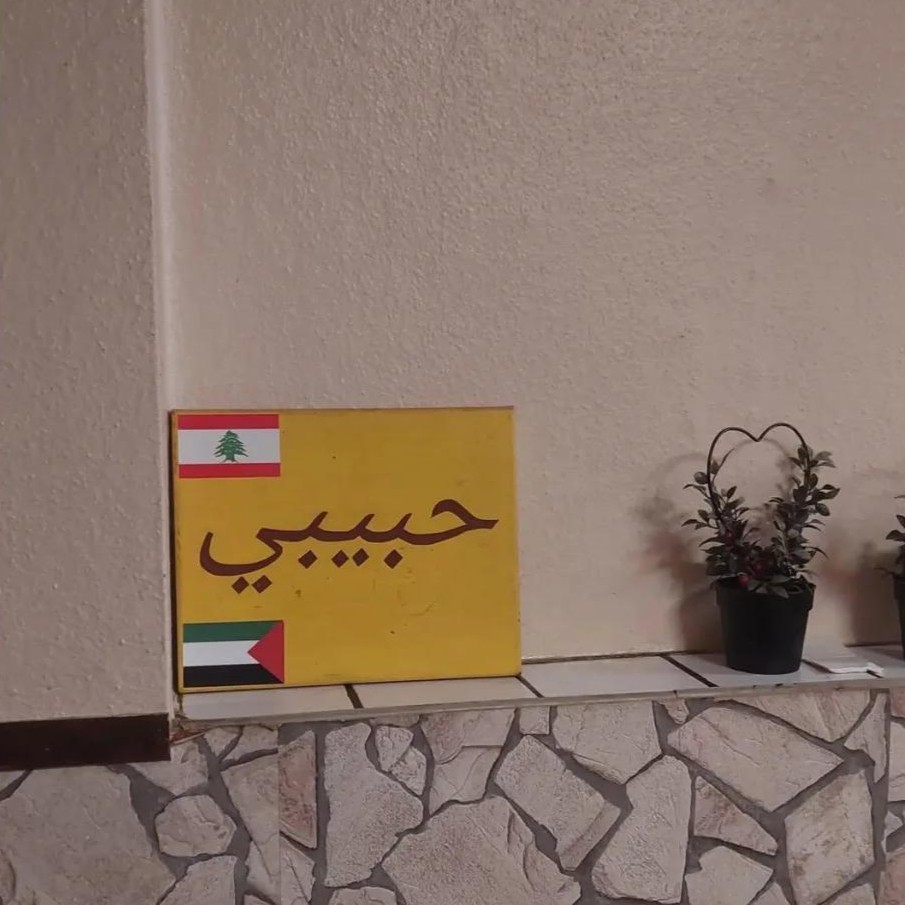
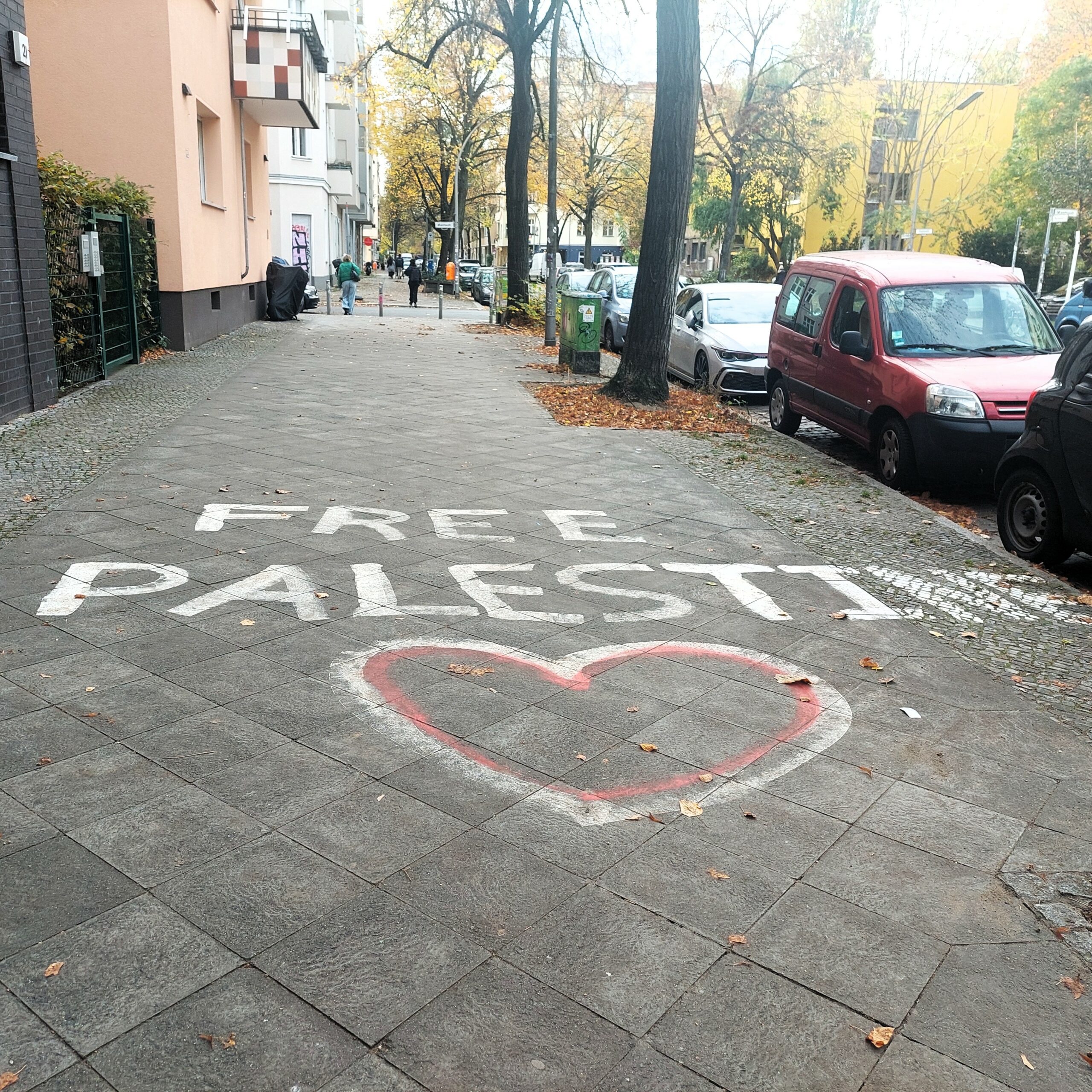
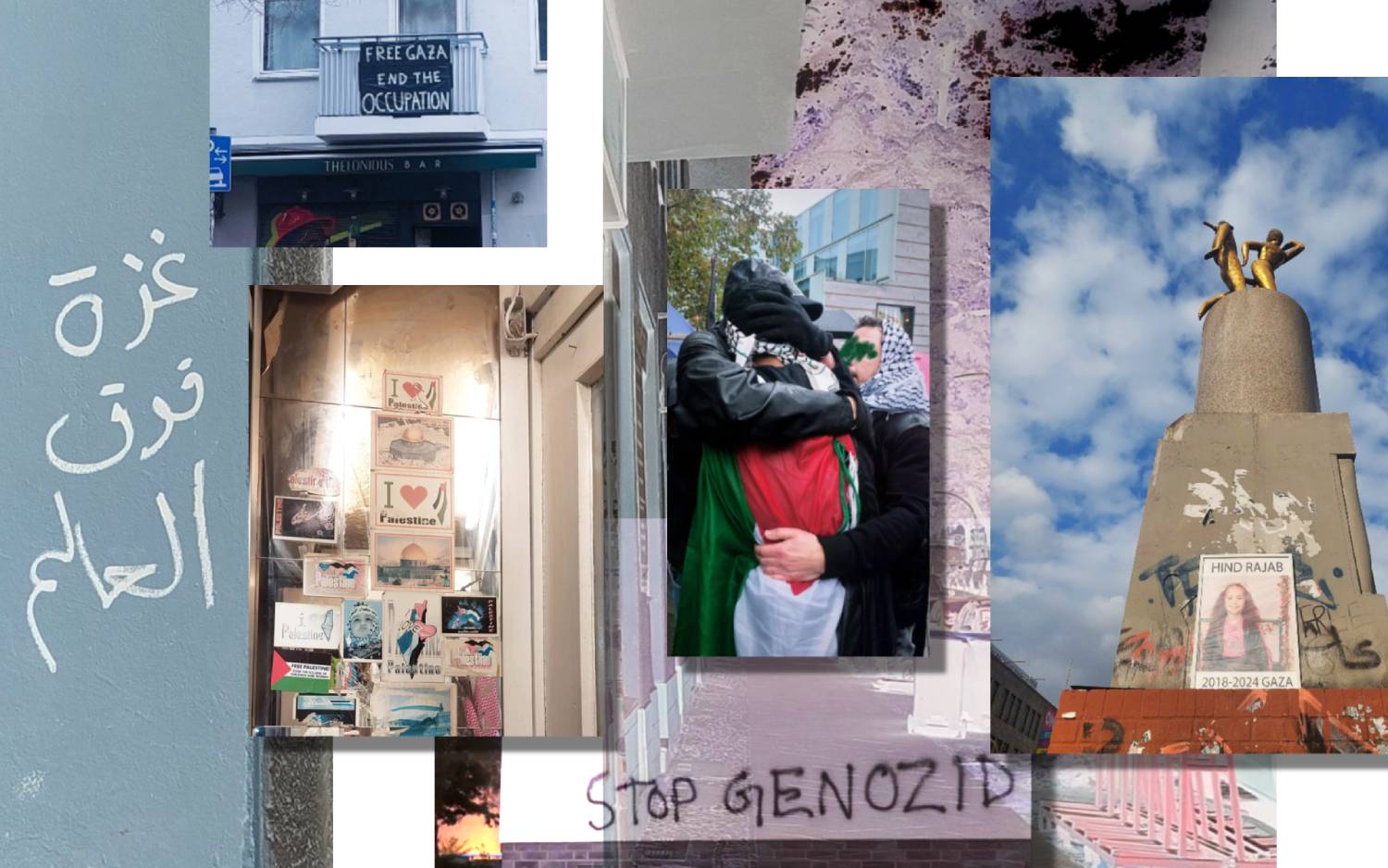
Scenes from Sonnenallee, also known as the “Arab Street”, in Berlin. “Free Palestine” and the word “Habibi” with the flags of Palestine and Lebanon at a local restaurant.
The experiences of migrants from Gaza living in Germany may intersect with those of the broader Gazan diaspora across the Arab world, Europe, and other regions, yet settling in Germany has its distinct hallmarks. In Germany, state institutions, along with a good chunk of society, are perpetually ready to support Israel, even throughout a genocide. The support masquerades as compensation for Germany’s former victim, Germany’s eternal victim. This dysfunctional dynamic, compounded by Germany’s own post-WWII psyche crisis, preemptively antagonizes Gazans who now reside in the country. Gazans’ identity is subjected to constant scrutiny, despite the fact that they are the victims of this current genocide.
This story attempts to begin to understand how Gazan men and women living in Germany have navigated these complex questions and struggles. How have they psychologically and emotionally endured their ghurba, within the exhausting socio-political particularities of the German context? This text seeks to dedicate space for storytelling; for allowing individuals to share their experiences, free of pressure or censorship[5].
Samah: “I find no solace…"
Shortly before I met Samah, I found out that our interview fell on her birthday. I texted her, suggesting a postponement that would allow her to enjoy her day without the burdens of these heavy-on-the-soul subjects we were about to engage. But she just brushed it off, insisting that we move forward with our talk. “Sometimes, you feel everything. Sometimes, you feel nothing,” she tells me, “And, today, I feel nothing.”
Samah and I found each other on Instagram sometime before her arrival in Germany, where I reside. We later met for the first time in Berlin, at the peak of the genocide in Gaza. I note now that the genocide has become our temporal frame of reference. We have come to understand the timelines and contexts of our life events through it, overshadowing the regular markers of our personal histories: anniversaries, travel, graduations… or birthdays.
Samah and her husband live in a small, quiet town in western Germany. She describes it as a place where nothing ever happens; a place that forces one into a state of isolation. The last time she had celebrated her birthday in Gaza was nearly five years ago, right before she traveled to a Gulf country for her master’s degree. After graduation, she did not get the chance to return, as the war had already begun.
“What has happened to our bodies, to our parents’ bodies, really?” Samah asks. “Every single day for over two years, our bodies have been hyper-alert, scared, tense, asking who died, who survived… It’s just not something our brains are supposed to deal with.”
In the spring of 2023, Samah graduated from university. She found a job in a Gulf city, and she started planning her return to Gaza, her marriage, and her migration to Germany to join her husband, where he studies and works. In October 2023, the genocidal war began. Samah stayed put.
“I had to stay. I was my parents’ only one outside Gaza, and so I was their only means of support. They lost everything.”
Samah decided to delay all marriage plans during the genocide. She decided they should wait, “but the genocide went on and on, for so long…”
Eventually, the couple had to marry away from family and loved ones, through a trans-continental marriage contract. She, in the Arab city where she works, her husband in Germany, her family in the north of Gaza, and her husband’s family in the south of Gaza. Everyone was completely cut off from each other, with a genocide raging in the backdrop of this young union.
“It was a very weird procedure. My husband and I made my father and my brother our respective legal representatives, and they carried out our Katb Ktab[6] ceremony for us in Gaza. With additional complex procedures, we were able to send the signed papers to Ramallah for authentication, and we submitted our family reunion file to Germany. Our marriage was very procedural.”
In late 2024, just a few weeks before she obtained her visa and traveled to Germany, Samah’s brother was martyred in Gaza. Life was never the same again. Her loss was now an ever-present shadow that accompanied every single day.
“Honestly, I just wanted to get to my husband at that point,” she says.
In the early days of 2025, Samah arrived in Germany.
I try to understand how she persevered, day in and day out, in this cold place. “Did you want to be alone, or did you try to engage in social activities and be with people?” I ask.
Samah says she consciously sought out demonstrations that set out in solidarity with Gaza: “I live in a small town where there is none of that political action, so I would travel to a nearby city where these events and protests were regular. In that Arab country where I used to live, we were not even allowed to organize solidarity vigils.”
“When I go to a demo, I think to myself, well, it’s good that someone still remembers us… But, to be completely honest, I feel nothing. I tell myself I’m doing this for my future children, if they end up living here… But in truth, I couldn’t really find meaning in it. My family is in Gaza, dying, so what is the point of what I’m doing here?”
“I hate being asked, ‘Where are you from?’ At first, I resented hearing that question from Germans because I feared their reaction when I answered, Palestine. But now I hate hearing it from anyone, Arab or German. I feel like everyone has put us in a box; reduced us to a stereotype. Gaza, to them, is one specific thing. I hate that look of pity in people’s eyes… Recently, I’ve become more avoidant of confrontation. There was an instructor I was supposed to take my next German course with. I learned that he held racist views, so I simply stopped attending the class and told myself I would continue to learn on my own. Avoiding conflict was never part of my character, but now I prefer it, because I have to stay here. I have nowhere else to go, and I don’t want trouble.”
Samah says that feelings of helplessness and guilt have continued to haunt her, yet she still attended the demonstrations. She explains that the protests gave her a sense of kinship. She would often find herself talking to people there.
“Once,” she recalls, “I met a young man from Gaza at a demonstration. He told me his brother was martyred while distributing humanitarian aid. I immediately blurted, ‘Oh! My brother was martyred while distributing aid too!’ And, no, that doesn’t give me solace, but at least I felt I had spoken to someone who understood what I was going through, you know?”
Samah’s questioning of meaning is a recurring theme. “Even during the truce, I was exhausted,” she says. “I felt it was all meaningless.” Eventually, despite her reluctance to rely on medication, she decided to give antidepressants a try. “I would rather endure the pain than take pills. But this time, after talking with friends and my psychiatrist, I decided to start the medication.”
The language barrier was one of the main obstacles to her finding a therapist in the town where she resides. She explains that even if her German improved, she would still prefer to see an Arab-speaking therapist, for reasons ranging from not having to explain obvious cultural contexts to fears about how non-Arab practitioners might perceive or interpret the ongoing genocide. Samah continued seeing an online therapist in Egypt, with whom she felt comfortable.
Yet the doubts persisted – doubts about the potential for healing, for picking oneself up, and for moving forward. “It all feels pointless. I say that with all respect to the important work psychotherapists do. I mean, I had gone to therapy before the genocide, and back then, the problems were things you could actually work through. But what has happened in Gaza… It’s something else. You never truly recover from something like this.”
Samah reflects on numbness. Part of her struggle with therapy and antidepressants stems from the – perhaps moral - question of attempting to escape pain. She recognizes that the medication brings temporary relief by dulling her emotions, allowing her, as she puts it, to ‘become functional again’.
“Even the very horrific, graphic videos that used to tear my heart out hit me differently now because of the medication. I do realize that I needed to take the medicine. I know that it has helped me power through. But I don’t want to stay on it long term, because this numbness… I don’t like it.”
“Why are you doing this to yourself?” her family in Gaza keeps asking her. They assure her she has done everything she can to support them and that they are deeply thankful that she is safe abroad. “It’s not a feeling I can control,” she says.
Samah carries an overwhelming sense of guilt, especially toward her siblings, ever since she left Gaza: “I constantly feel as though I abandoned them. That feeling goes back to before the genocide, to the moment I left to live in a country where electricity and water were always available. The thought of having running water used to make me cry. It felt so strange to enjoy those comforts while they couldn’t. I would tell them, ‘Please, forgive me,’ and they would say, ‘Why are you talking like this? None of this is your fault.’ My family kept telling me, ‘Live your life.’ But I wasn’t with them during their recent displacement, when they truly believed they were going to die. I wasn’t there when my brother was martyred, or during the famine[7].”
“The famine! My God… The thought that I could eat while my siblings had nothing… It was worse than the shelling, worse than death. My family was trapped in the North, completely cut off, without even drinking water. How was I supposed to go on living with that knowledge? You know, they would tell me, ‘You lived this genocide with us,’ but the truth is, I didn’t live any of it.”
I tell Samah what she already knows: that she endured a different form of torment. It may not have been hunger or the terror of incoming missiles, but it was a fire on the inside nonetheless. A brutal, unrelenting anxiety, a constant worry for every single person she loves dearly. She knows all this very well, as she continues to ward off the fire for as long as she can, every single day. And yet, if given the choice, she says she still would have preferred to be there beside them, fighting their fires—with her family.
Ahmad: A Palestinian-German who returned from genocide
Vast distances and worlds separate Khuza’a in Gaza from Germany’s Münster. They are worlds that Ahmad crossed decades ago. In Münster, he found an opportunity for a new beginning: he pursued his degree, married, raised two children, and eventually secured a position at a renowned university.
I first got to know Ahmad some six years ago, when I was a student at the same academic institution where he worked. He would often ask me about Lebanon’s worsening economic collapse, and I would ask him about the situation in Gaza and the rare visits he had managed to make after leaving it.
Shortly after October 7, 2023, I tried to contact Ahmad to check in. My repeated calls went unanswered. Weeks later, I came across a local news report about a Palestinian-German man and his son who had returned from Gaza after enduring weeks of the ongoing genocide. There, in the video clip, sat none other than Ahmad, briefly recounting parts of his ordeal to the press.
When I recently sat down to talk to him, it felt only natural for our conversation to begin with that most recent journey back to Gaza - the homeland that had changed in his absence just as he himself had changed away from it. A Gaza to which he happened to return only a few days before the genocidal war erupted.
What follows is Ahmad’s account of those days.
“I actually went to Gaza for my son. He feels more emotionally connected to Gaza than I do, even though his first visit there was only in 2023. He has spent his entire life in Germany, and when he turned twenty-three, he began a search for his identity. He was always struggling with German society, or rather, struggling with himself in German society. The conflict was within him, not with others. He was eager to really get to know his relatives and, at some point, he made the effort to learn Arabic by himself.”
“My son and I traveled to Gaza together in April 2023 for less than a week. Later, during the summer holidays, he returned on his own and spent five weeks there. I could see that he was incredibly happy during his time there. He adapted so easily and quickly. He was feeling great, making friends there - something I had never really seen him do so easily before. He even got to know relatives whom I myself barely know, because an entire generation was born and raised in Gaza while I was away, including the children of my nieces and nephews.”
“You know how it is… Sometimes we feel that German society is somewhat cold, emotionally, and that people take forever to let you into their lives. That’s because we’re used to people being very warm back home. You meet someone, chat a bit, and within half an hour, he’s your homie.”
“A little while after that summer vacation, my son and I returned to Gaza on October 2, 2023. We had such a beautiful time the first five days. I felt happier than I’ve ever felt in Gaza during that visit. We spent most of our time at the beach with family members, who were mostly busy preparing for my niece’s wedding - scheduled for October 7th…”
“We, in Gaza, love festivities. We love having a good time. Weddings are not a single-night event; they go on for days before the big ceremony.”
“I was unusually at ease during that stay. Things seemed relatively calm, unlike an earlier visit some fourteen years earlier, when tensions between Fatah and Hamas were at their peak. After this, Gaza endured five successive and exhausting wars in the span of a few years.”
Then came the morning of October 7th. Ahmad’s days of bliss in Gaza took a dark turn.
“My son and I woke to the sound of rockets being launched from Gaza. I was terrified. More terrified than I had ever been. Never in my life had I witnessed his intensity of rocket fire. In the streets, everyone was cheering and praising God. A while later, uncertainty began to creep in. Ok, now what happens?”
“My mother began to wail. She is an elderly woman who knows Israel and its barbaric history all too well. The first words she uttered were: “Wallah, Illa Yenkabouna”; “By God, they are going to bring a Nakba[8] upon us”. Her village was close to Khuza’a. Her family had been forcibly displaced by Israel from there to Khuza’a, and much of their land was seized by the occupation. Khuza’a itself was among the first villages to suffer massive destruction during the wars of 2008 and 2014, situated as it is on the front lines near the border. So, they always take it out on us first. Khuza’a was also one of the first places from which people were displaced.”
Leaving Gaza?
Ahmad had not yet directly addressed my question about what had changed in his relationship with his second home, Germany, in light of the genocide in his homeland, Gaza. Yet the answer was partly embedded in his description of his and his son’s attachment to Gaza, and his recounting of the experience of witnessing part of the genocide. These experiences would shape much of his position in/from Germany in the months that followed.
Ahmad witnessed the events of October 7 firsthand. Unlike the overwhelming majority of Gazans, however, he had a European passport: a chance at leaving. He made his first attempt to reach the Rafah Crossing with his son, but Israel bombed the crossing. He then contacted the German Embassy, but they were “completely unprepared to deal with the situation,” as Ahmad put it. “Even though Germany dispatched a military aircraft to Cyprus to evacuate not only Germans, but also Israelis wishing to leave,” Ahmad notes. “Within hours, they had mobilized the resources for their evacuation and set up camps for them in Cyprus. Gulf countries opened up their airspace for them. Some fled to Jordan or Egypt as though they were going for tourism…”
A bitter sarcasm takes over his tone: “I guess you could say the ‘Free World’ was starting to mobilize to try to rescue the other ‘Free World.’”
He paused and revised: “Technically, we were supposed to be part of that ‘Free World’ too. My son, at least, since his mother is German. I just wanted to get my son out, then we’ll see.”
“The German Embassy told me they bore no responsibility for people inside Gaza. They claimed that the embassy warned German passport holders not to enter the Gaza Strip.” Ahmad said that had been an outright lie: “I always checked the embassy’s statements. No such warnings had been issued.”
Like every parent in Gaza, Ahmad’s foremost concern was protecting his son and finding a way to get him away from danger.
“Whenever I looked at my son, I felt completely overwhelmed. He had relatives his own age, friends with whom he spent his time… They were martyred while sitting in cafés as they usually do. He could have been there. The thought haunted me.”
“I started having specific dark ideas. I had this fear that he might get lost, and that because he didn’t speak Arabic very well, someone might mistake him for an escaped Israeli captive,” he said.
Ahmad remembered getting lost in Gaza himself during an earlier visit. After more than thirty years away, the streets had changed so drastically that he barely recognized them. “A group of young men stopped me and questioned me aggressively,” he recalled. “Then a passerby heard me mention my family name and recognized it. ‘Are you the one from Germany?’ he shouted before rushing over to hug me and send the boys away.”
Ahmad’s experience sounded painfully paradoxical. He had tried to get the Germans’ help, but they left him stranded, as though he were somehow “not German enough”. Simultaneously, he was navigating Gaza during a genocide with a sense of anxiousness for his son’s safety because of his broken Arabic, as though they were somehow “less Gazan than they should be.”
“Would you say your dual identity became a double burden?” I ask him.
Ahmad does not agree with the way I described the situation. Instead, he explains that he never expected any society or nation to treat him as completely one of their own. “Germany can treat me as a naturalized citizen. That’s fine with me,” he says, adding with unmistakable sarcasm: “Let the blond-haired Germans leave first. I don’t care. My problem is not that I want to be completely German. My problem is that [as a German citizen] I expected some kind of response to a very urgent, very catastrophic situation…”
“In the first weeks of the war, thousands of civilians were killed indiscriminately, in their homes, on the streets, everywhere. I went out to buy bread one time, and the bakery was bombed,” he recalls. “People died right in front of my eyes, still holding bread in their hands. Bread literally soaked in blood. Shortly afterward, more people arrived asking for bread. Hunger is a terrible thing.”
“Try telling this to Germany. Here, the moment the subject turns to Israel, all conversation halts.” Ahmad recalls the overriding mood in Europe and Germany, in particular, in those early weeks: unverified media narratives alleging mass rape, and children burned in ovens and hung from clotheslines. “A new Holocaust against the Jews, they called it,” he says.
Struck by a bullet… from outside Gaza
Ahmad has no interest in presenting himself as a victim, nor does he like pointing fingers of blame. He is acutely aware of the privilege he possessed simply in being able to escape the genocide at all. Yet there is one moment he recalls that jarred him and shook him to his core…
“I was sitting there watching the news, trying to understand what Germany was up to,” he says, “when I saw the German Foreign Minister at the time, Annalena Baerbock of the Green Party, repeating Netanyahu’s rhetoric, justifying the killing of civilians if fighters were hiding among them.”
“It was utterly weird. This was someone who speaks constantly about justice, equality, and women’s rights, and there she was, echoing the words of the Israeli Minister of War!”
“To this very moment, in all honesty, I haven’t been able to stomach it. I mean, I wasn’t struck by a missile or hit by shrapnel in Gaza, but that statement felt like a bullet to the heart.”
“Of course, I realize Germany’s relationship with Israel is askew, but still… This was intolerable. It was as though she had given Israel permission to kill: Yalla, continue.”
“At one point, Biden paused the shipment of a certain type of artillery shell to Israel,” Ahmad notes. “But Germany went ahead and sent another 4,000 of the same type of weapons. That made me even more furious. Not only that, the German Chancellor suggested he would find a way for Netanyahu to visit Germany despite the ICC’s arrest warrants against him. What message does that send?” Ahmad asks. “That Israel has absolute immunity?”
“France, Spain, and even the UK were objecting. Mass popular protests were taking to the streets across the world. But Germany kept making statements like these. I mean, enough of that! Shut up, at least! It was maddening. Baerbock’s remarks reached me while I was still in Gaza, seeking Germany’s protection. The meaning of it was that killing this man and his son was justified by Germany,” he says.
“To this day, I can’t brush off the deep irritation I felt hearing it.”
Eventually, Ahmad managed to leave Gaza. Shortly afterward, he was able to evacuate his mother to Egypt through the Rafah crossing, after paying a great sum of money. The German Embassy rejected her request to join her son in Germany.
The reason? “We suspect that once she arrives in Germany, she will not return to Gaza.”
The same Gaza that German-supplied weapons had helped devastate.
Auto-negotiations
Now, Ahmad frequently travels back and forth between Germany and Egypt. He cares for his mother in Cairo and stays for extended periods of time whenever he can. “I think I’m searching for an alternative homeland,” he says.
He seems infatuated by Egypt and its people. He adores their sense of humor against all hardship and says that, unlike the people of the Sham[9], who “stay with the melancholy,” Egyptians possess a remarkable ability to “let the sadness slide”:
“I love how Egyptians say: Let it go, man. Allah knows the problem, and only he knows how to take care of it. Just leave it to Him.”
Ahmad finds comfort in Egypt. He escapes to what he calls its “social warmth” whenever he gets the chance to travel. He feels that life in Germany is changing, perhaps even regressing. With the current rise of right-wing parties and ideologies, he no longer trusts what the country promises.
“This country has a dark history of stripping people of their rights and their lives,” he says. “It has a horrific past, with Jews among many other peoples. And not just once, but repeatedly. It is a history saturated with violence against humanity. I’ve read a lot about it… Sometimes I wish I hadn’t.”
I ask whether his relationships with German colleagues and friends have changed since the genocidal war began. He immediately says that his group of German friends are “well-educated people” who have shown him genuine solidarity. He also notes that, after his return from Gaza, his workplace management offered him time off and allowed him to work from home as needed.
Even so, Ahmad senses a deeper shift in his relationship with Germany and his life in it. He describes subtle but deeply revealing signs of emotional exhaustion inside his German world.
“Over time, I’ve started struggling with the winters,” he says. “I used to ride my bike everywhere. I barely noticed the rain or the cold. In fact, I kind of enjoyed it. There’s a German saying: ‘There is no such thing as bad weather, only unsuitable clothing.’ I truly lived by it.”
“This morning, as I rode my bike under a light snow, it was like everything was working against me. The snow was so dry and heavy. I felt its cold sting on my face. You know, this is the first winter here that I’ve actually resented.”
Ahmad pauses a bit, then speaks: “Maybe it’s not the winter; maybe it’s me.”
“There are things I used to absolutely love here. Christmas, for example, and all the celebrations that come with it. This year, I felt relieved that I was too sick to attend any holiday parties. None of it means anything to me anymore.”
Even the celebrations that once connected him to home no longer move him as much. “All the Palestinian and Arab weddings I used to love don’t mean much to me now either. All the happy noises of the world… I don’t want it. If I ever feel like dancing, I’ll play music at home and dance alone.”
I sit there thinking about what Ahmad had said to me in an earlier conversation - that he sometimes wished he had not come to know so many members of his extended family during the genocide and their displacement together in Gaza.
“It’s true. I wish I hadn’t had the chance to know them better. Once you learn their eye color, recognize their voices, know what they like, and how they think… You start to care more and worry about them. It hurts more to know them.”
Ahmad has noticed something else shifting in his habits. An avid reader with a deep love for the German language, he once found immense pleasure in reading German literature. But in recent months, he says, he has struggled to read even two pages without feeling a tense annoyance: “It’s almost like I can’t really stomach their language, their culture, anymore.
In the hope of forcing himself back into reading, he deliberately kept buying German books. “I see them piling up on the table,” he says. “I try to push myself to finish a book I’ve started, but I just can’t.”
I ask him whether he has reached a point of complete rupture with Germany.
He pauses a little, thinking. “If it is,” he finally says, “then it is a painful rupture. To say goodbye to this place and this culture would be painful for me.”
“What still ties me to this country, above all, are my children. And if this really is a rupture, then it carries a psychological cost. I loved this country. I spent the best years of my youth here, in its streets, its universities, and my workplace. It gave me stability. It offered me opportunities in every aspect of life. It’s not easy to just break away.”
He looks for words to express exactly how he feels: “Let me put it this way: I am living in a state of confusion.”
Ahmad undergoes his own negotiations with the self. This “confusion” is not his alone; we all sense it: an open-ended question about our relationship to the world; an unresolved reckoning unfolding underneath the long shadow of genocide.
Attempts at mental resilience
There was one particular incident to which I return, and which I believe was the beginning of my question about how people endure genocide from afar.
Last year, I attended a psychosocial workshop organized by a Berlin-based NGO focused on the mental health of migrants and refugees[10]. The workshop was reserved exclusively for women, and among the participants was Umm Waseem.
She was one of those people with an unmistakable commanding presence: cheerful, unwavering in her convictions, and nearly impossible to argue with. She brought a life force into the room and carried herself with a warmth that made her instantly feel like an old friend.
Umm Waseem was from Gaza. During the genocidal war, she fled to Egypt through Rafah with her children. She then managed to reach Germany as one of the few recipients of a “humanitarian visa.” So life in Germany was still entirely new to her.
At one point during our workshop, she stepped outside to answer a phone call from a family member in Gaza. This was a period when the genocide and the starvation were at an all-time peak.
When Umm Waseem returned to the room from her call, she quickly blurted out, as if to avoid our concerned, inquisitive gazes: “My brother tells me there’s no food at all. Well, what can I do about it? All I can do is eat for the both of us.”
Her deeply dark joke brought about some hurried, uneasy smiles from the group. No one commented. Umm Waseem abruptly moved on to other issues.
Perhaps she was desperately trying to spare everyone the burden of comforting her. And perhaps she needed to spare herself unwanted looks of pity. Such was her way of confronting the horrors unfolding in Gaza, at least during the few times I met her. She would throw out the sharpest comment, then immediately redirect the conversation to practical matters: what she can do to pick herself up, here and now, in her present conditions.
I went home that day thinking about Umm Waseem and her ability to wield sarcasm and bleak humor as shields against fragility and despair. I thought of all the ways people who are away from their families at war attempt to protect themselves from collapsing - quietly, almost invisibly, yet with immense dignity.
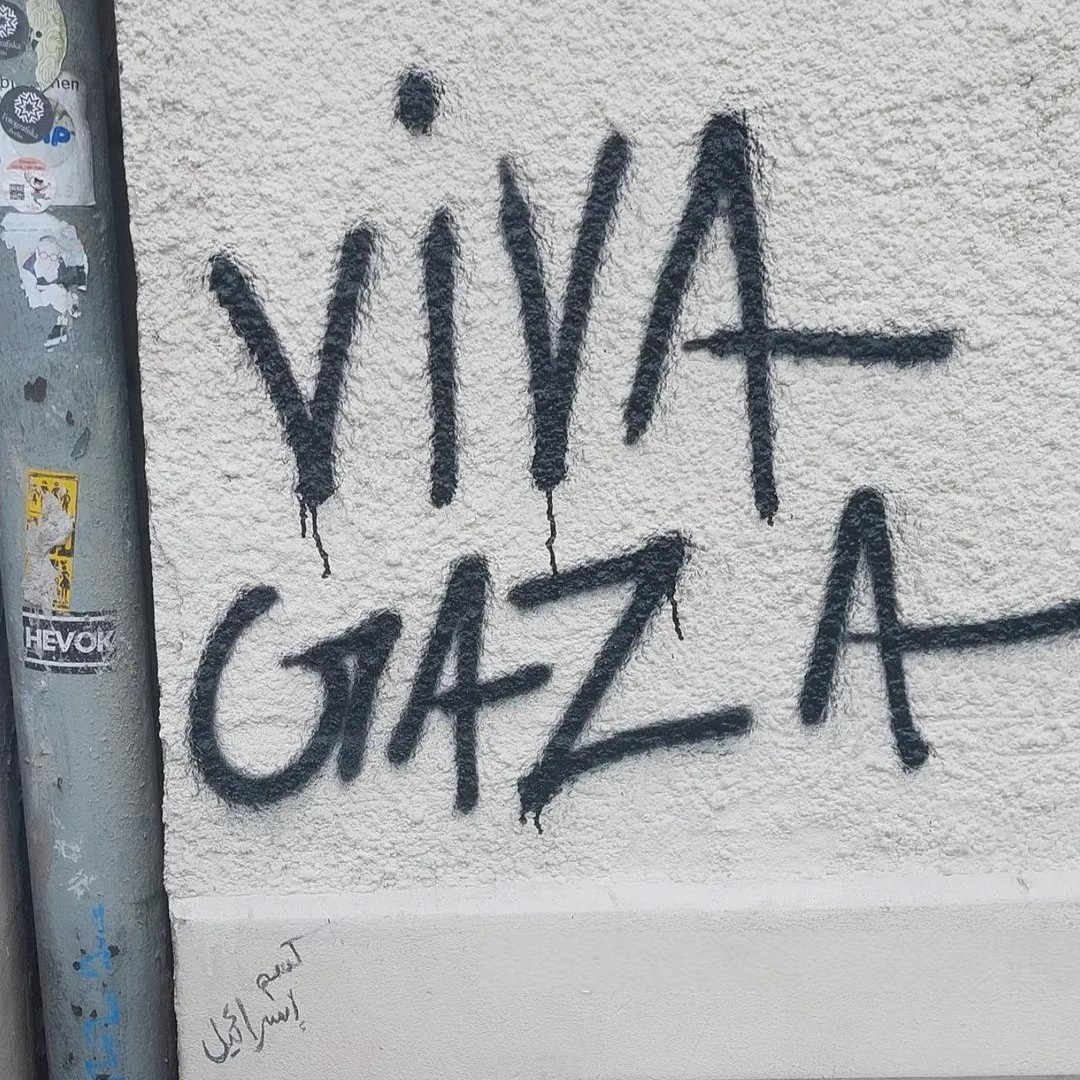
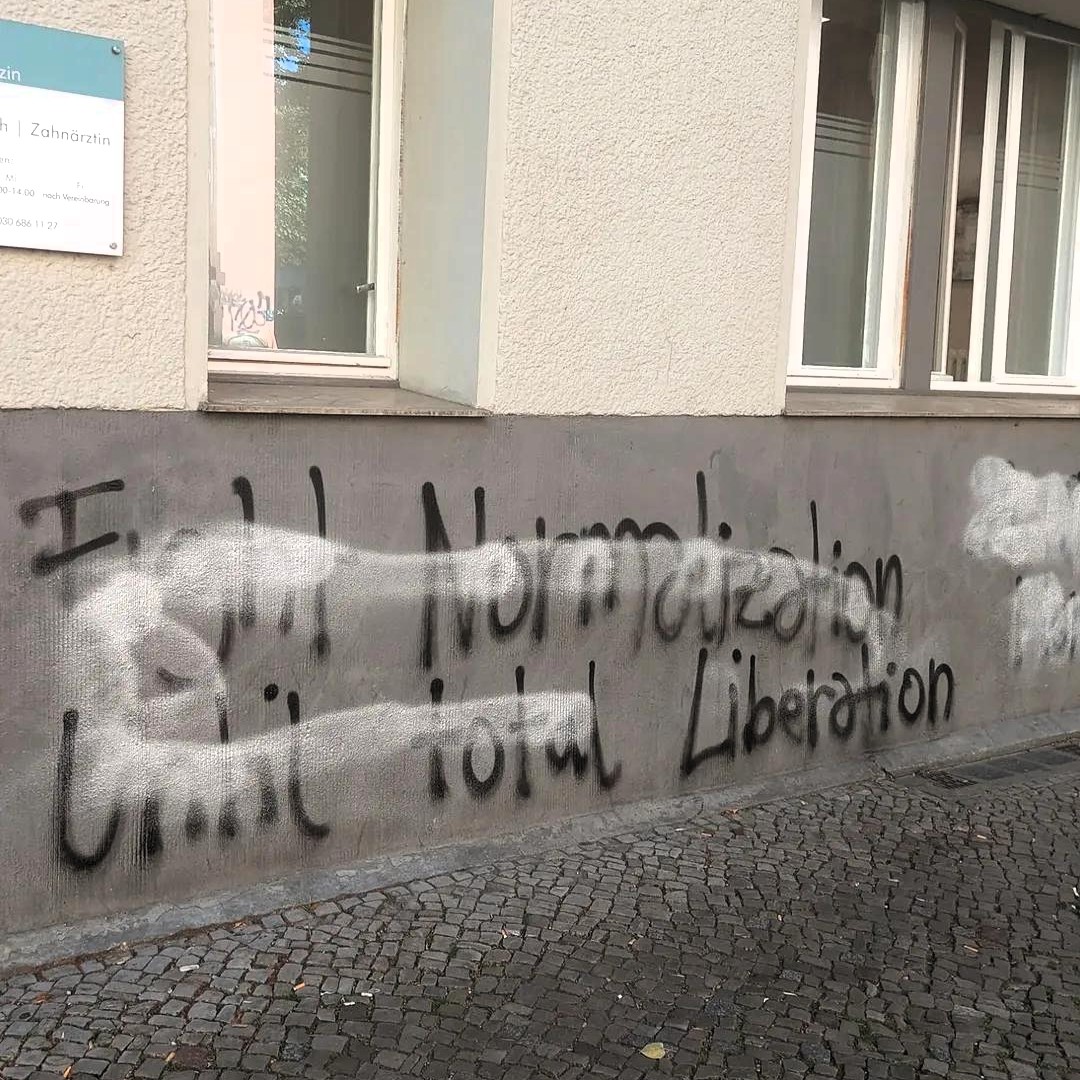
Messages on walls: “Viva Gaza”, “F*ck Israel”, and a partially erased “Fight Normalization until Total Liberation”.
I wanted to speak about all this with Salma, a Berlin-based Lebanese psychosocial counselor who was also the facilitator of the workshop I had attended with Umm Waseem earlier. Salma recalled a particular individual session she held during the early months of the genocide with a young man from Gaza who lived and studied in Germany.
She tells me, “His wife and children were still in Gaza. Before the genocide, he had already been trying to bring them to Germany through family reunification procedures. After the genocide began, and because he felt personally responsible for taking care of everyone and believed he had to remain strong for them, he struggled even to make time for himself, or for therapy.”
“Shortly before the war began, his children had sent him some gifts. The package arrived while the genocide was underway. So he refused to use any of the practical items they had sent him for his home.”
“His way of dealing with it was almost as if he had frozen time,” Salma said. “He put the gifts aside and told himself: ‘When the war ends, and they come here, then I’ll use them.’”
During the session, he showed her the items one by one. Salma recalls feeling that, in his mind, preserving the gifts untouched had become a kind of pact with fate: so long as he honored his promise to wait for his family, they would remain safe.
“It was as though he were saying: ‘They will arrive. They will be okay. Nothing bad will happen to them.’ And I was a witness to this pact.”
Salma notes that we come from societies that still attach stigma to seeking psychological support. Often, people turn to therapy only once the psychological stressors in their life have become unbearable, meaning when a psychological issue begins to demonstrably affect their functioning in daily life.
“Most people come because of concrete symptoms: forgetfulness, panic attacks, nightmares, social withdrawal, and so on. These symptoms may stem from the trauma caused by witnessing the genocide, or from post-migration stressors…
“Usually,” she says, “they are not seeking answers to abstract philosophical questions. They come for practical, immediate reasons, […] which speak directly to their vulnerable situation.”
In her experience, most immigrants and refugees tend to think of their problems in practical terms, focusing their attention on whatever helps them create some semblance of stability for themselves and whatever helps them support their families. Those arriving from Gaza, in particular, are occupied with the most urgent/immediate priorities: Who survived and who didn’t? Will my paperwork be approved? Will I be deported?
For Gazans who have lived in Germany for years, however, Salma explains that part of what they are currently going through can be described as value conflict. The very ideals that once drew many of them to Germany, such as financial security, equal opportunity, and personal freedom, have exceedingly come under painful scrutiny in light of Germany’s position toward Gaza during the genocide.
It is as though a certain faith has collapsed: “a kind of loss of innocence,” Salma calls it.
She notes that many who had previously avoided confrontation are now less inclined to remain silent. “People who once ignored uncomfortable political stances at work, or preferred to stay quiet, no longer feel the need to do that,” she explains. “After what happened in Gaza, many feel they no longer have anything left to lose.”
Salma believes in the centrality of the consultation room as a vital space to study the internal worlds of the persons who have suffered difficult experiences, from genocide to post immigration stress. She takes us by the hand back to that space, even when the causes behind the suffering are immense and systemic, because- she insists- “each person has his or her own sensibilities. Everyone experiences and processes these experiences differently.”
“We may see ten people exposed to similar pressures, coming from comparable social, financial, and regional backgrounds,” she says, “yet each of them responds in a completely different psychological way.”
To overlook those particularities, she argues, is to reduce their experiences into a stereotype and deny the nature of a very real, very personal suffering.
Of course, Salma does not dismiss the structural causes of human suffering; those that are far beyond our ability to control or change in the foreseeable future. She believes her role, as a therapist, “lies not in keeping people fixated on realities they cannot change in ways that leave them feeling powerless.”
“Instead, I ask: what can I do today for the people I love and for those who come to my counseling sessions? Here,” she says, “we look for available resources, whether internal[11] or external.”
Her professional experience has taught her that improvement comes not through big strides, but by small, consistent steps taken over time.
Salma’s approach to therapy reminds me of the advice often emphasized by Palestinian reconstructive surgeon Dr. Ghassan Abu-Sittah: “Don't think about the size of the problem, think about the capacity you have to help, because what we can accomplish is very important.”
In the face of forces as immense as war, genocide, or oppressive global systems, it is easy to get overwhelmed and succumb to helplessness. Resistance lies in preserving a sense of agency, no matter how seemingly small.
Epilogue: Tears in the fabric of reality
Seasons change.
Trees outside my window lose all their foliage, become green again, and repeat their cycle.
It’s business as usual in the European continent.
Neither the genocide in Gaza nor the war on Lebanon has halted.
We, the exiled, are here and there at once - a daily limbo between worlds.
In these unaware streets, our bodies receive none of the signs of imminent, life-threatening danger. Yet our nervous systems are alert, perpetually expecting bad news...
A young woman with a Keffiyeh around her neck passes by me on a Berlin street.
My phone screen lights up: bad news again.
Two dogs howl at each other at the corner of the street, while their humans laugh and tug at their harnesses.
On my phone screen, I try to decipher, from a wobbly, blurry video, the exact location on our street where this missile hit.
I don’t quite understand what I’m looking at.
Something is off with this scene, and an undefinable sentiment brews inside me.
[1] The state of feeling alienated, isolated, and homesick as a foreigner in a faraway land or unfamiliar setting.
[2] Exorbitant fees were collected by the Egyptian authorities for those who left Gaza during the genocide. The Rafah crossing is currently closed to Gazans.
[3]‘Voluntary’ emigration of hundreds from Gaza to Germany, France kicks off under ‘family reunification’ scheme. Published in Mada Masr. April 24, 2025.
[4] Germany hosts the largest Palestinian community in Europe, estimated at 100,000-200,000 people. This figure may, in fact, be higher, as some Palestinians are registered under other nationalities or categorized as "stateless" or "of undetermined nationality," according to the Interactive Encyclopedia of the Palestine Question. More than 45,000 of these Palestinians reside in Berlin.
[5] All names of participants and individuals interviewed or mentioned in this report have been altered or limited to first names to protect their privacy.
[6] The formal Islamic marriage ceremony and contract signing.
[7] The systematic starvation perpetrated by the Israeli genocidal army and occupation against Gazans, through the blocking of essential food trucks from entering the Strip, and the bombing, burning, and contamination of a significant portion of agricultural lands, flour mills, and food processing plants, thus severely depleting markets of vegetables, fruits, grains, and even flour.
[8] A reference to the Nakba, the Catastrophe of 1948.
[9] Lebanon, Syria, Palestine, and Jordan.
[10] A non-governmental organization providing free psychosocial care services to migrants and refugees in multiple languages, including Arabic.
[11] Salma mentions, for instance, the case of Umm Waseem, an engineer in Gaza who took great pride in her work. Upon arriving in Germany during the genocide, she was forced to live in a shelter and could no longer practice her primary profession. She set a clear goal for herself that gave her purpose and helped her avoid succumbing to despair: to leave the shelter and rent her own apartment. She took up work, preparing food for meager wages. Although she sometimes feels sorry for herself, she quickly jolts herself back up. Her sense of purpose keeps her going. This is a case of an "internal resource" that contributes to her psychological resilience.