
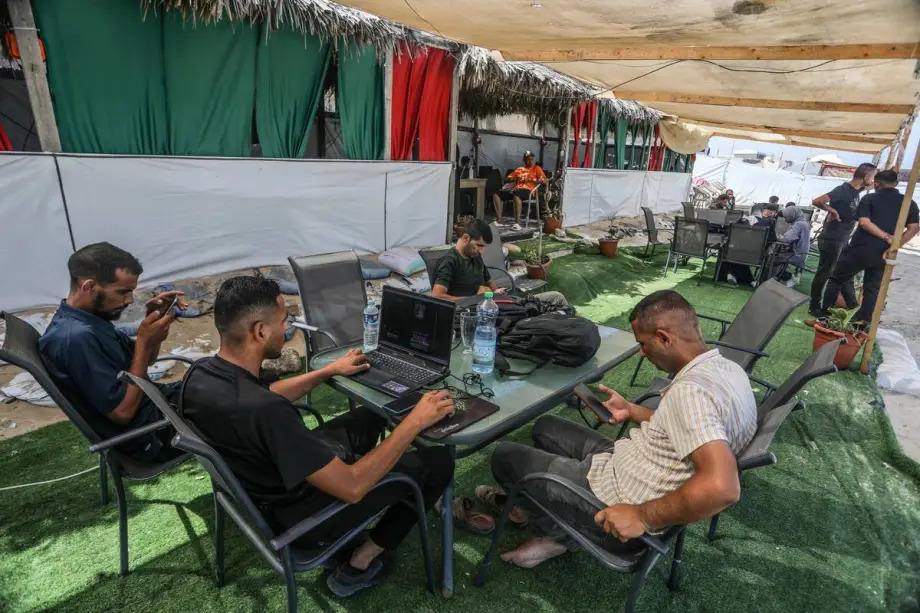
Global development discourse celebrates the digital economy as a democratic space that dissolves geographical boundaries for anyone possessing the necessary skills and an internet connection, thereby granting individuals equal opportunities to participate in global markets. It frequently highlights the millions of opportunities the internet offers young people in war zones, enabling them to transcend the economic conditions of their home countries. However, this democracy collapses when faced with the overwhelming reality of the Gaza Strip, revealing, in this small, besieged enclave, the dark side of digital economic globalization.
According to a 2021 International Labour Organization (ILO) report, the number of digital labor platforms multiplied five times between 2010 and 2021. While the report highlights the creation of job opportunities for youth, people with disabilities, women, and those marginalized in traditional labor markets, it also admits to the digital gap between the Global North and South[1].
Gaza stands as the embodiment of the contradiction between empowerment and reality: you find yourself there, waiting for a borderless world to open its doors to you, while all possible physical borders are closed around you, from land, sea, and air siege to digital isolation. So, if the internet dissolves geographical borders, what happens when geography itself is besieged and bombarded? And how does the geographic siege transform into a competitive advantage in the global market and an effective tool for exploitation?
Gaza before October 7th
Young people in Gaza turned to remote freelance work as a strategic option to circumvent the blockade and the crumbling economy. Sixteen years of the Israeli siege imposed on Gaza since 2007 had completely devastated traditional productive sectors, along with repeated wars and the systematic impoverishment policies enforced by the occupation authorities. All of these factors pushed unemployment rates to over 50 percent[2]. At the same time, universities in Gaza were graduating thousands of young people every year, yet the highest percentage of graduates in the Arab region is met with the highest unemployment rate in the world. In this context, remote work served as the only way out for these skilled people, it neither required a border crossing permit nor security approval, just an internet connection to link them to a job market not controlled by the occupation, even though that occupation still controlled electricity and communications.
This gave rise to digital business incubators in Gaza, led by Gaza Sky Geeks, founded by Mercy Corps with support from Google in 2011. In 2018, the organization launched a partnership with Upwork platform, which trained over 4000 freelancers in Gaza. By 2022, a full-time freelancer was earning an average of $1110 per month, more than four times the average local wage[3].
Despite the importance of this work in a besieged area, when this number is presented as a success story, one has to ask: success compared to what? Compared to Gaza's poverty? Or compared to the actual value of the work itself in the global market? Whatever the answers may be, this work wasn't really an opportunity as much as it was the only road left with no other choice, under a siege system designed to choke every other economic channel.
After October 7th
When the genocidal war broke out, the occupation army systematically targeted the communications infrastructure. They destroyed more than 80% of communication networks, 90% of the fiber optic network, 84% of the copper network, and completely destroyed about 55% of cellular sites[4], resulting in losses exceeding 223 million dollars in the communications and information technology sector during just the first six months of the war[5]. Israel also cut electricity supplies to the strip, and the only power plant stopped working due to the lack of fuel, leading to near-total blackouts. Amidst repeated displacement, bombing, losing loved ones, fragmentation, and lack of clarity regarding unfolding events, all these conditions made the very idea of sitting down to complete a work task almost impossible. Hence, most workers stopped working.
The highest percentage of graduates in the Arab region is met with the highest unemployment rate in the world. In this context, remote work served as the only way out for these skilled people, it neither required a border crossing permit nor security approval, just an internet connection to link them to a job market not controlled by the occupation.
There has been a rise in digital business incubators in Gaza, led by Gaza Sky Geeks, founded by Mercy Corps with support from Google in 2011. In 2018, the organization launched a partnership with Upwork, which trained over 4000 freelancers in Gaza. By 2022, a full-time freelancer was earning an average of $1110 per month, more than four times the average local wage.
No one expected the war to last this long. As it dragged on, savings ran out, purchasing power collapsed, prices skyrocketed, and the economy completely fell apart. There was no income and no supporting institutions. This pushed young people to go back to work. One must say that given the total lack of job opportunities and the current situation for young people in Gaza, anyone who can still work remotely online is considered lucky. But holding on to this “luck” made workers more vulnerable to exploitation. The fewer alternatives they have, the less room there is for negotiation.
The financial siege
Young people in Gaza face a geographical and physical siege that imposes material and physical constraints on their ability to work, in addition to a financial siege that is no less severe. Since international financial platforms (like PayPal) are banned and restrictions are placed on bank transfers, receiving payments became an exhausting process. Workers are forced to rely on local intermediaries or complicated networks of trusted people outside Gaza to receive their money, and every person involved takes a cut of the amount. This financial strain is compounded when clients themselves are afraid to financially deal with Palestinians, out of concern for possible repercussions in their own countries, even when they can prove the payment made is for actual work done. Two people I spoke to for this article mentioned that they still haven't received payments owed for work completed prior to October 7th. Their clients completely cut off contact and stopped replying to any messages as soon as the war started.
Israel destroyed more than 80% of communication networks, 90% of the fiber optic network, 84% of the copper network, and completely destroyed about 55% of cellular sites, resulting in losses exceeding $223 million in the communications and information sector during just the first six months of the war.
One remote worker told me he receives his money in a friend's account in Europe, who sends them to someone else, who hands them over in cash to a third one, until they finally reach him.
Local banks also act obstructively, imposing difficult rules to prove the nature of the work. They classify individual accounts as personal accounts, forbidding their use for any business activity, while refusing to open business accounts that allow to receive money from abroad. This pushes young people to use a long chain of people who exploit them. One remote worker told me he receives his money in a friend's account in Europe, who sends them to someone else, who hands them over in cash to a third one, until they finally reach him. Those who don't have trusted relatives or friends abroad have to deal with a local intermediary who receives the money in their account for a commission of up to 15%, then transfers it to a bank account. The recipient must then pay a cash withdrawal fee of up to 30% just to access their money.
Postponed Funerals
06-08-2026
It is a vicious cycle for workers in Gaza, who already pay high operating costs to deliver their services, only to give up a large portion of their earnings just to finally touch their money, all while prices have multiplied dozens of times over.
Operational costs as a competitive barrier
In any conventional employment relationship, the employer covers the cost of production. The opposite happens in Gaza. When workers stopped working at the start of the genocide because of the overwhelming conditions, and later had to return to work, they had to find solutions for the provision of electricity and internet. Some had to buy solar power systems at enormous costs. During the war, the price of just one solar panel reached six thousand shekels, only to power a laptop. This panel doesn't work without a battery that costs more than the panel itself, plus a device to connect the panel to the battery, not to mention regular maintenance costs for the whole system. Those who can't afford this go to cafes and workspaces that provide electricity and internet, which Israel targeted and still targets.
Later on, electricity became available through street generators, local commercial power networks run by companies or investors, supplying residents with alternative electricity for a monthly fee. Subscribing requires paying both the connection costs and the price of the electricity itself, which kept rising due to the siege and repeated crises like fuel shortages and lack of spare parts for generators. The price reached 30 shekels per kilowatt-hour, while before the war it averaged around 3 shekels.
None of this accounts for the cost of buying and maintaining the electronic devices used for work, whose prices have multiplied several times over compared with pre-war prices, largely because they have become extremely hard to find as border crossings remain closed. Ultimately, workers must finance this entire operational infrastructure out of their own pockets just to remain available for work.
This high cost of working does not translate into fair pay. Instead, many clients see Gazan workers’ reality as a chance for exploitation. They know how limited their options are, and that they may be willing to accept any offer, so they try to push their rates lower. As one remote worker told me: "People outside might be able to do a job for 10 or 15 dollars, but you have to ask for 35 dollars just to cover your costs, not even to make a profit." Yet competitive market pressure forces him to go lower than that. How can a Gazan compete in the global market when the service he provides costs several times more than the same service from a person in a stable country? He explains: "You have to be unfair to yourself and price your service as if it were low-quality, even though it's actually excellent. You have to lower your rates because, otherwise, you simply can't compete."
Geographical identity as a barrier
The obstacles also include outright refusal to deal with someone simply because they reveal their geographic location. One remote worker told me he lost clients as soon as they found out he was from Gaza: "There would be work lined up, and when they know I'm from Gaza, they stop. They don't even think to apologize, they just stop replying to messages." When the genocidal war started, clients he had been working with in Europe for months stopped sending him any work, without any explanation, "even though they liked the work". The fear of repercussions associated with dealing with Gaza extends to the entire professional relationship, not just the financial side.
This rejection based on location has pushed some Gazan workers to hide their identities. Those who can't get a non-Palestinian WhatsApp number pretend to be from the West Bank rather than Gaza, fearing the loss of a client who might back out or stop responding once they hear the name “Gaza”. This becomes an extra burden that is completely unrelated to their skill or the quality of their work.
Absence of legal protection
In the digital labor market, there is no local labor law governing this type of work, nor is there a judicial authority workers can turn to in the event of a dispute with a client. More dangerously, however, workers themselves adopt this as a defensive strategy from the outset. One worker told me: "There are no contracts, because we can’t guarantee we can stick to the contract, and we're afraid of sudden emergencies like power cuts, internet outages, displacement, or bombing." He prefers an informal agreement that allows him to withdraw without repercussions if he had to. He goes on to describe a time he had to decline an urgent job requested by a client: "I didn't know what to say to him. I took a picture of myself packing my things to evacuate, not knowing where I was going, and I apologized for my inability to do the work."
During the war, the price of just one solar panel reached 6000 shekels, only to power a laptop. This panel doesn't work without a battery that costs more than the panel itself, plus a device to connect the panel to the battery, not to mention regular maintenance costs for the whole system.
And here lies the paradox: the same absence of legal protection that leaves the worker unable to claim his rights also gives him a way to avoid being held accountable in the event he is unable to complete a job. Therefore, workers give up on the only tool that could protect them and preserve their rights. The contract becomes a risk they must avoid, and the whole relationship remains based on unwritten trust, which the client can walk away from at any moment without any obligation.
An act of resistance or an act of surrender?
Based on everything above, it is difficult to definitively characterize the moral nature of remote work in Gaza. The dominant narrative tends to portray it as a heroic act, proving to the world that willpower is stronger than any circumstance, often accompanied by images of young Gazans working from cafes or searching for an internet signal at the beach. But one worker puts it in its proper context: "This work is full of exploitation, suffering, and exhaustion. Wherever you go, it is a struggle. But to be fair, it has helped us a lot, because right now there are no jobs available."
This sums up the contradiction at the heart of the Gazan worker’s experience. It is neither an act of resistance, since resistance assumes a choice between available alternatives, nor an act of surrender, as the worker did not give in so much as been backed into a corner. Remote work becomes an act of survival, nothing more and nothing less, regardless of how much the romanticized narratives of resilience attempt to idealize or beautify it.
• Translated from Arabic by Ruba Hassan, reviewed by Sabah Jalloul
-
Rapid growth of digital economy calls for coherent policy response. https://tinyurl.com/2tjt4psy ↑
-
هل كان اقتصاد غزة قبل السابع من أكتوبر اقتصاداً "طبيعياً"؟ https://tinyurl.com/bdh3jycz ↑
-
Upwork and Gaza Sky Geeks Bring Remote Work To Gaza. https://www.upwork.com/blog/upwork-and-gaza-sky-geeks-bring-remote-work-to-gaza ↑
-
هيئة تنظيم قطاع الاتصالات: عامان على حرب الابادة… قطاع الاتصالات في غزة بين التحديات المستمرة وآمال التعافي. https://tinyurl.com/mspddy3u ↑
-
دمار في البنية التحتية للاتصالات بغزة جراء الحرب.. أعطال وانقطاع متكرر.