

" This file was produced as part of the activities of the Independent Media Network on the Arab World. This regional cooperation brings together Maghreb Emergent, Assafir Al-Arabi, Mada Masr, Babelmed, Mashallah News, Nawaat, 7iber and Orient XXI."
A reader might recoil in shock, perhaps even get a case of the nightmares, after learning the stories of the people of Iraq or Syria. Even more unsettling are the tales gathered from both sides of the border, smuggled across lines like drugs, weapons, or human beings. They are the stories of people whose lives have closed in around them.
This text examines the journeys of people imploring life on both sides of a border, holding on to the illusion that all hope, or their last hope, lies beyond these borders as a final frontier.
Travelers to Sinjar today would not miss the colossal wall stretching along the Syrian border. It rises on the horizon like a fence encompassing an empire of horrors, kept inside, lest they break loose exposing stories that would shatter the sanitized narratives promoted by governments on both sides on the border. The wall towers over the land, impenetrable to the masses who once crossed freely when they decided to escape their “great national death”, delivered to them by barrel bombs and the “pure and pious” Takbir[1] cries. Designed to span 614 kilometers, around 400 kilometers of the wall have already been constructed. The barrier is a concrete structure reinforced with tunnels and thermal cameras, intended to secure the border with Syria, as Iraqi authorities in charge of this project have declared.
The mountain’s open wound
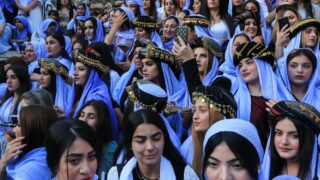
More than half a million Yazidis once lived in Sinjar, under the protection of the sacred Mother Goddess[2]. Within hours, their homeland turned into a ghost town. Women were transformed into commodities traded in slave markets, men were rendered into skeletons jumbled in mass graves, and children were lured by fanatics who wanted to recruit them as future-suicide-bombers.
As the sun set behind the mountain, families climbed onto the rooftops of their mud homes to escape the summer heat. Men took their positions behind makeshift barricades, armed with rusty, light weapons, ready to resist ISIS militants alone, after the forces assigned to protect the area withdrew without warning. Two hours of sleep was all the residents of Tel Azir had before waking to the sound of gunfire. Death was approaching like a sky closing in.
At dawn, the families fled toward Mount Sinjar, which majestically towers over all with a fatherly presence. Each stone on that mountain knew an untold history of a forgotten genocide. The fleeing made their way to the Siyaye Valley, gathering at the mountain’s foothills. Once settled, women became the center of the group’s world. Every conversation, every worry and concern revolved around the women; how to protect them, and how to respond if ISIS reached them after taking over the residential areas.
Death is a Woman from Şingal
05-06-2024
ISIS had tried to reassure tribal elders of its “peaceful intentions,” hoping to lure the refugees back from the mountain to its proposed “peaceful” Islamic State. ISIS attempted to convince the families to pledge allegiance to its emirs and normalize ISIS presence in the area. Soon enough, the true face of their crimes was exposed: men executed, young girls abducted, elderly women abandoned, killed, and buried in mass graves.
In Tel Azir, fourteen women from the family of Mahmoud Kharro were abducted by ISIS. The men of the family were killed, while elderly women and children were spared only because ISIS militants were pressed for time and had to leave. One witness reported that some women spent four days beside the bodies of their sons or brothers before fleeing to the mountain, where they told others about the massacre. On the mountain, there were chilling calls to kill girls and women if ISIS fighters approached, as the men believed death would spare the women the cycle of rape and being bought and sold from one captor to another, and would spare the men from witnessing it.
As a friend tells me her story, she asks me: “ISIS wanted the girls. That was their only war spoil. Our families decided to kill us. I keep wondering: where was our voice – the girls’ – in the midst of it all?”
The story of Jaylan, a young girl who took her own life after being kidnapped by ISIS, echoes my friend’s question. She and other abducted girls were given dance dresses and ordered to bathe before being displayed. According to Amnesty International[3], Yazidi girls were systematically raped. Some committed suicide to preserve what they called their honor; others were spared only to be kept for emirs who demanded “untouched merchandise”. The same report mentions the testimony of one girl who said that no one wanted to buy her because she was “ugly,” and for that, she was thankful to God.
In August 2014, many on the mountain died of dehydration. The lack of basic resources and dehydration amid the searing heat claimed the lives of ten to fifteen people every day – most of them children[4].
Tens of thousands of Yazidis marched like a file of ants across the Iraqi–Syrian border. At that moment, the wall had not yet been built, and the border presented the only path to survival.
Aid was airdropped, haphazardly, over the refugees who suffered hunger and thirst, but even aid took its share of Yazidi lives. One witness recalls: “It was after midnight when the silence of the mountain was shattered by a loud thud. We fled the area, but an aid box landed on a woman sleeping near us. Imagine going to sleep while starving, having food fall from the sky on top of you, and never waking up!”
Mount Sinjar, whose peak was said to have scarred Noah’s Ark in all its mightiness, was now scarred by the tears of Yazidi women who lived in terror, fearing rape, death, and the unbearable loss of their children... Their tears spilled onto the bone dry boulders of the mountain.
Refugees under the sun
After nearly ten days in the mountains, and as threats grew, panic filled the hearts of Yazidi refugees. A corridor into Rojava (Syrian Kurdistan) was opened by the People’s Defense Units (YPG). Thousands of Yazidis walked for hours under a merciless sun that cooked the bodies of their children; a feast for the Goddess of death. They buried the small bodies on the road and trudged onward. Their wounded mountain spat them out into a journey that seems never-ending; a perpetual pain.
A Girl like a Bamboo Reed
18-07-2025
Young men carried the elderly, while women covered their faces, fear flickering in their eyes. In the hearts of parents, pain swelled as they looked into their children’s dusty faces and cracked lips. They were burdened by the terrible unknown of their children’s future. Sometimes it seemed as though every Yazidi child was his parents’ future heartbreak.
Ghosts of dust were raised by the marching of bare feet, engulfing the procession. Eyes stared blankly into a future melting in the mirage of a distant horizon; the Syrian border. They walked approximately 129 kilometers before reaching the town of Derik. Their bodies could barely carry them beyond the border. Exhausted and depleted, they only wanted their journey to come to an end, whatever that may be.
“Fearing that we might be taken for conscription, our families told us – women - to hold our male cousins' hands, so that the People's Defense Units (YPG) would think we were married,” a witness who made that journey told me.
Mount Sinjar, whose peak was said to have scarred Noah’s Ark in all its mightiness, was now scarred by the tears of Yazidi women who lived in terror, fearing rape, death, and the unbearable loss of their children... Their tears spilled onto the bone dry boulders of the mountain.
Tens of thousands of Yazidis marched like a file of ants across the Iraqi–Syrian border. At that moment, the wall had not yet been built, and the border presented the only path to survival. If borders were meant to define nations, in this particular case, breaking borders was an absolute necessity; it defined life. In other words: the border was the only escape from a domestic death that made no distinctions, a death distributed equally among Iraqis.
According to the Union of Yazidis of Syria (Yekîtiya Êzidiyên Sûriyê), a grave was recently built for an unknown Yazidi child who died during the march. He was named Bêkasê Farmanê[5]. Bêkasê arrived at Derik Hospital wounded and died three days later. He was buried in an unmarked grave, until individual efforts managed to build him a headstone.
The Yazidis who had fled to Syria crossed back into Iraqi territory, on foot, through the Fishkhabur border crossing into the Kurdistan Region. There, they encountered others who had risked their lives to make the same long journey.
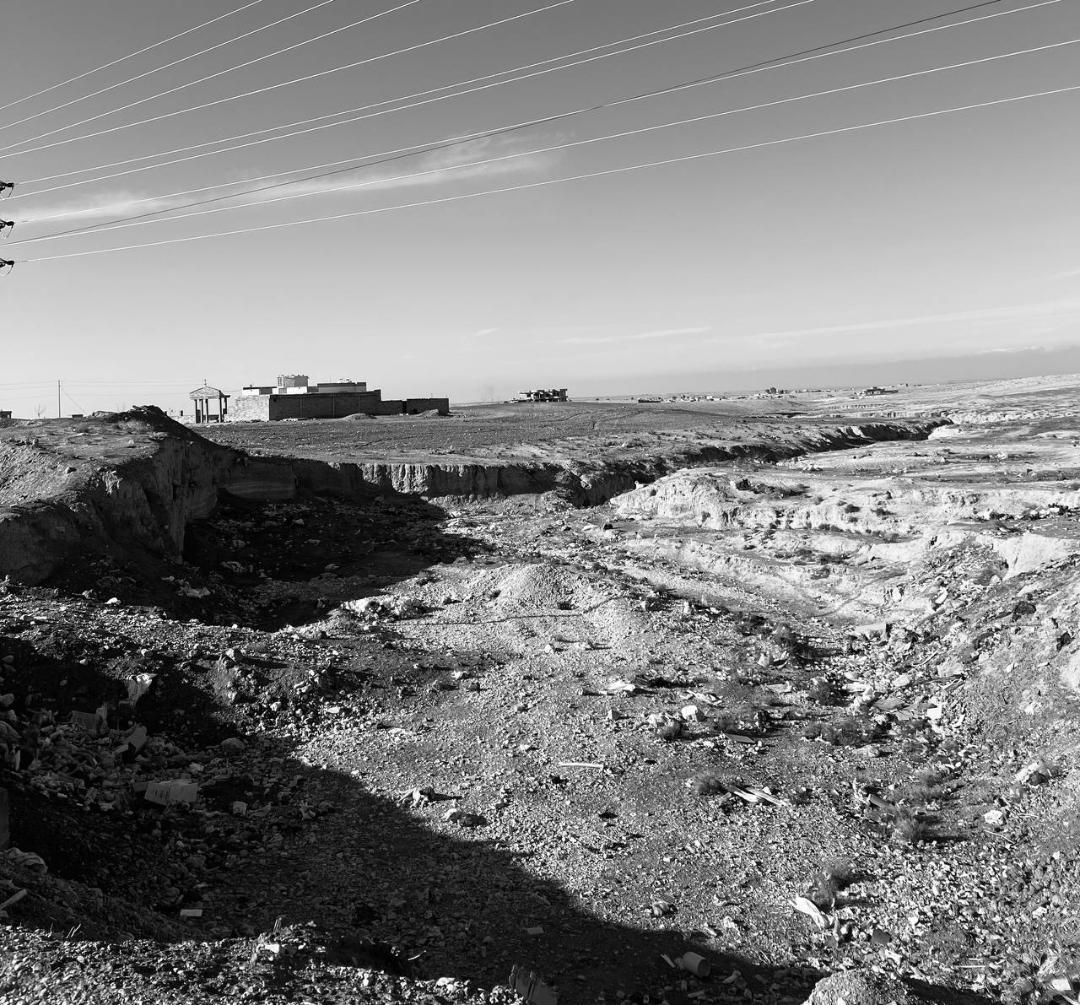
In the first months after their return, hundreds of thousands of Yazidis lived in the open; on streets, beneath trees, or inside unfinished building projects, packing tightly together. Survivors feared for those left behind on Mount Sinjar. They were no longer worried about those who had perished, resting in mass or individual graves; they feared for the living and for those taken captive.
More than a decade later, over 100,000 Yazidis remain displaced in camps across Kurdistan. Dozens of mass graves have yet to be discovered, and several thousand abducted women and children are still missing. Every now and then, some women are “bought back” from ISIS traffickers through the efforts of their families or humanitarian organizations willing to pay for their release. Others have been freed from Syria’s al-Hawl camp, which houses the families of ISIS members.
The Iraqi government has framed its engagement in al-Hawl camp not as an effort to liberate Yazidi women, but as part of an “international commitment” to dismantle the camp, following reports that describe it as a breeding ground for renewed extremist ideology - a so-called ticking time bomb.
The Land of Clipped Braids
23-03-2025
The Iraqi government has been making serious efforts to abruptly close displacement camps, as a way to dissolve the displacement issue while allowing itself to evade responsibility for liberating kidnapped Yazidi women held across several countries, including Syria, Turkey, and others, and for rebuilding destroyed towns and rehabilitating survivors. Instead, under directives from the Prime Minister’s Office and the Ministry of Migration, the Iraqi government provides 200 liters of kerosene and a replacement tent every few years.
As construction of a 400-kilometer border wall between Iraq and Syria continues, so do efforts to prevent the return of individuals suspected of ISIS affiliation, yet without accountability for ISIS members who committed sexual crimes against Yazidi women. Despite this, Yazidis remain today among tents and destroyed homes, enduring displacement and hate speech even within the camps wherein they sought shelter.
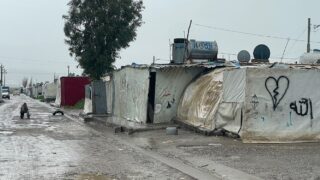
Not far from the Yazidi camps in Dohuk, in Iraqi Kurdistan, lies Domiz camp, one of the largest Syrian refugee camps in the region. Domiz is home to an estimated 6,000 to 8,000 families who arrived in 2012. But how did they arrive there?
In the tent… Gasping for air and dreams
Northern Syria, under the control of the Syrian Democratic Forces (SDF), is known in Kurdish as Rojava, or Western Kurdistan. It is a region shaped by tension, much of it rooted in decades of Baath Party rule and policies aimed at Arabizing the area. These pressures have fueled Kurdish nationalism, which has grown with each cycle of repression and, in turn, has been exploited and manipulated by local and international powers alike. Peace has long been elusive. For thousands of Syrian Kurds, leaving became the only viable solution. They crossed the border into Iraq, into the Kurdistan Region specifically, or Bakur in Kurdish, meaning Southern Kurdistan. But how did they cross over, and how long is their stay?
According to the Union of Yazidis of Syria (Yekîtiya Êzidiyên Sûriyê), a grave was recently built for an unknown Yazidi child who died during the march. He was named Bêkasê Farmanê. Bêkasê arrived at Derik Hospital wounded and died three days later. He was buried in an unmarked grave, until individual efforts managed to build him a headstone.
Tens of thousands of Kurds abandoned all their belongings and crossed the Iraqi–Syrian border, where Domiz camp was established. Over time, the camp expanded to cover roughly 1.14 square kilometers, 20 kilometers southwest of Duhok. At its peak, Domiz received around 80,000 refugees. Today, it is home to approximately 8,000 families who had fled the war. Some arrived after walking for hours, others by swimming, and some by whatever transportation means they could manage. From the outset, the camp took in far more people than its intended capacity.
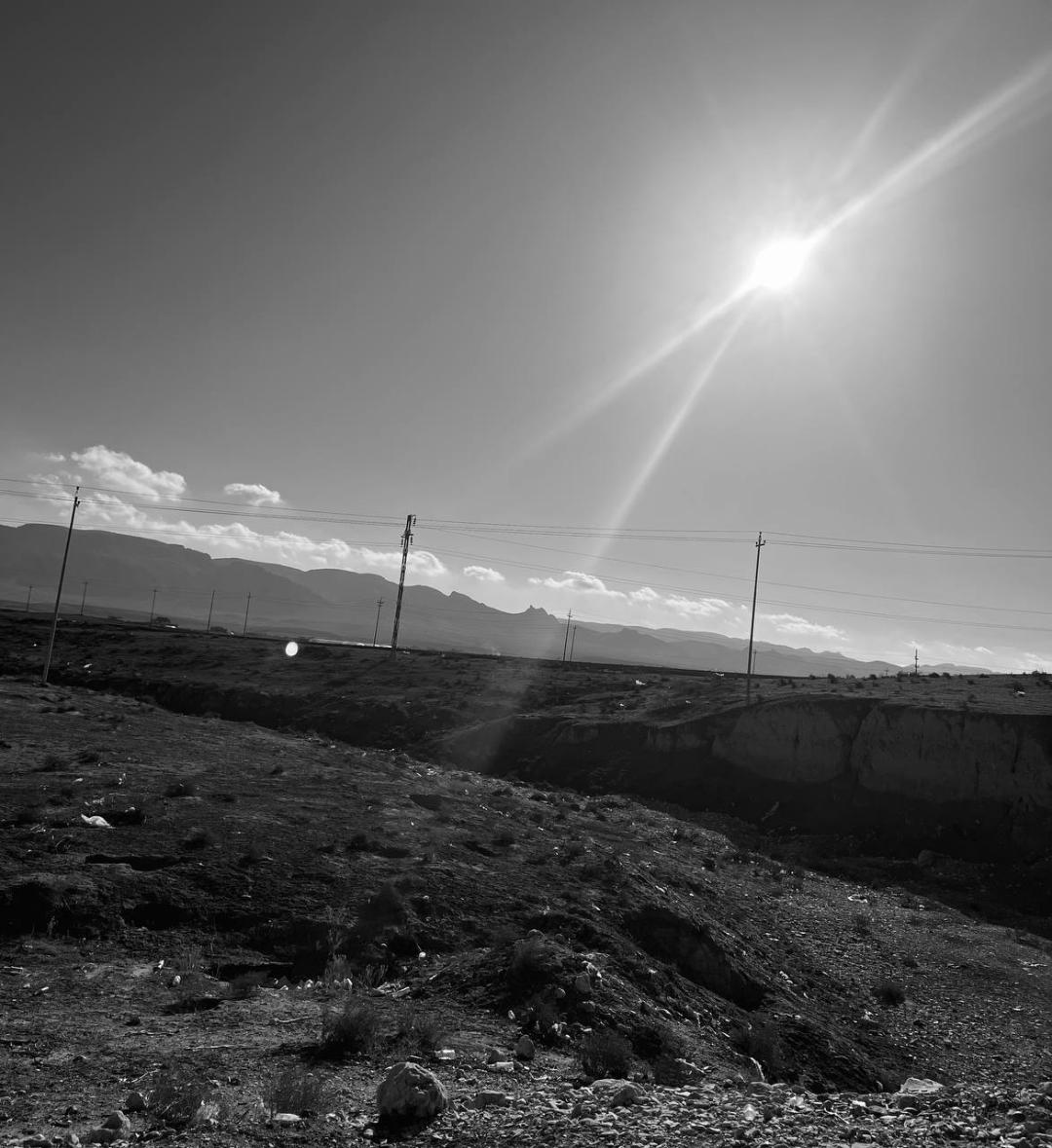
Hala remembers how she first entered Domiz, tired and covered in dust collected on her journey on foot. Uprooted from her home and pushed across a border, she arrived with only part of her family; the rest were still on their way. Those who made it had their hearts ablaze with a fire that burned like the Nowruz flame, lighting the darkness of the tiny tent. The tent was a haven for insects and a hell of longing and heartbreaks for homes left behind in Rif Dimashq.
The donated blankets distributed to them, the water bottle Hala had to wait in line to fill, even her mother’s presence - none of it altered the truth. Her life had slipped through her fingers like sand. She had to learn to live like this; empty-handed, stretching her arms out in every queue, enduring her pain with the instinct of survival. Fourteen years later, Hala says she still has not learned how to live as a refugee. She chooses to live on nostalgia instead.
Testimonies collected by the International Organization for Migration (IOM) exposed violent accounts of the displacement journeys. One witness[6] reported that bodies lay in the streets of their town for four days or more. Another account[7] described how some families crossed with the help of smugglers and were shot at along the border, losing some of the family members before ever reaching Domiz.
A decade and a half later, thousands of Kurds find themselves scattered across refugee camps in Iraqi Kurdistan. According to testimonies from residents, many factors prevented their return, including the ongoing conflicts between Damascus, the Syrian Democratic Forces, and the Kurdish regions which also suffer from intermittent Turkish military operations, in addition to fears of having their sons taken away, conscripted as fighters.
Yet life in Domiz camp persists through the labor of women who work all sorts of jobs, despite meager wages. They send their children off to European countries, and remain behind battling a life that lacks basic services, especially in healthcare. Emergency services are often absent, and when clinics do operate, they are frequently short of essential medicines. Residents are forced to make long, costly journeys to the city simply to receive basic medical care.
As for education, the camp lacks qualified teachers across nearly all subjects, creating persistent obstacles to learning. Although Domiz has “developed” into a something that resembles a city, with concrete rooms replacing tents, the schools remain little more than caravans, devoid of every basic educational resource, and lacking heating in winter and cooling in summer. The future of these schools, like that of the camp itself, feels uncertain and perpetually volatile.
Despite these hardships, the residents of the camp are reborn each day. They take root in the camp’s earth, allowing their spirits to grow anew. Imagination, after all, cannot be confined by the camp’s current borders, nor by dreams of stability and progress, because the camp never ceases to grow, adding new homes and paving new streets without fail.
Education in displacement camps
In displacement camps, including those housing Yazidis, the educational process has long been neglected, so much so that it cannot be taken seriously. For years, education has survived largely through the personal efforts of families, who paid monthly fees to teachers who were unqualified to teach the subjects they taught. Parents purchased textbooks for their children, despite the fact that free textbooks are a right for every Iraqi student. Although billions of Iraqi dinars are allocated annually to the Iraqi Ministry of Education, families have also been forced to collect donations from their pockets to purchase heating oil for their children’s winters classes.
A 2024 UNICEF report[8] called on the Iraqi Ministry of Education to extend educational services to displacement camps, following its decisions to close some camps in the Kurdistan Region. The decision was a hasty attempt to ostensibly “resolve” the displacement crisis, without actually offering a durable solution for the displaced, and without addressing the conditions in areas from which they fled.
Education in Iraq: The Detours of Collapse
04-01-2024
These conditions threaten the resilience of an already fragile and underfunded educational process. Today, the fate of students remains unknown, as it is unclear whether they will be expelled from their camp schools, whether educational institutions serving the displaced will end up entirely shut down, or whether they will be left in a state of indefinite precarity.
Imagination, after all, cannot be confined by the camp’s current borders, nor by dreams of stability and progress, because the camp never ceases to grow, adding new homes and paving new streets without fail.
Beyond education and health, camp residents face daily risks to their lives and livelihoods. Fires regularly engulf nylon tents, claiming lives and destroying what little property families possess. Meanwhile, the voluntary return program promoted by the Ministry of Migration has been arbitrarily suspended, as was the release of compensation payments for destroyed homes and the issuance of 7,000 property deeds promised to displaced families.
There is a profound lack of support for education, physical and mental healthcare, and other basic services. This neglect is part of a larger pattern affecting Yazidi and Syrian Kurd displaced persons alike, despite decades of proclaimed local and governmental efforts. These claims have yet to translate into genuine commitment or concrete actions that might pave the way to a dignified return to their homelands, thus bringing the camps issue to an end.
What makes camps life-worlds?
Refugee camps are, by definition, temporary or semi-permanent spaces—places of last resort for those fleeing almost certain death. They are administered by international migration organizations and humanitarian agencies, supposedly governed by universal principles of protection and human rights. In practice, however, treatment is often shaped by the “reputation” of one’s country of origin. The rights meant to safeguard refugees rarely extend to people from the Middle East - certainly not to Syrians and Yazidis.
Despite the harsh conditions and the self-serving policies of host states, over time, these camps turn into the only livable option available. People cross borders to find safety, but end up in a prolonged state of displacement. The lives of Yazidis and Syrian Kurds are proof of this. Outsiders often reduce the camps to crude stereotypes: the camps are spaces of “chaos and prostitution,” as they are labeled by surrounding communities. Those same communities frequent the camps’ markets to find cheaper products. The camps also serve as reception points for women survivors of ISIS prisons, who had endured terrible mental and physical torture, and for their families.
But so many questions linger. Can such camps truly endure? And for how long? Will the tents grow old? And will the concrete rooms that are built no bigger than a tent crumble with time? If the tents never disappear, will the state eventually drape them in a giant scarf to hide them from view; to save the state’s international image and parade its so-called “achievements”?
- Translated from Arabic by Sabah Jalloul.
- Part of the folder “Arab World: Evolving Borders and Flows”.
- All photos in this article are taken by the writer.
- ISIS sometimes used the words “Allahu Akbar”, which mean “God is great” to declare their crimes and justify them in the name of God. ↑
- Şingal, another name for Sinjar, is derived from a Sumerian-Cuneiform linguistic construct that combines “Şin,” meaning woman, and “Kal,” meaning goddess. ↑
- https://www.amnesty.org/en/documents/mde14/021/2014/ar/ ↑
-
According to the testimony of a doctor to Human Rights Watch.
https://www.hrw.org/news/2014/08/09/nightmare-iraq
↑ - Bêkasê does not have a precise translation, but it has come to mean “orphan” or “without kin,” while Farmanê means “genocide.” Together, the phrase translates as “orphan of the genocide.” ↑
- https://youtu.be/KS1V-Lf30Sc?si=sbdSH6gt-Pxc3Kg9 ↑
- https://youtu.be/2WBDbxEhCfA?si=6S3x4y74N7G1pO6D ↑
- https://www.unicef.org/documents/iraq-humanitarian-situation-report-no-1-mid-year-30-june-2024 ↑